
Search demand for a static mixer design calculator is really demand for the handful of equations behind every vendor's sizing tool. They are not secrets — here is the full chain, with the two constants you must always get from the element manufacturer.
1. Velocity: A = πD²/4, v = Q/A
Every design starts by converting volumetric flow Q into mean velocity v through the cross-section of the chosen diameter D. Nothing else in the chain works without this number.
2. Reynolds Number: Re = ρvD/μ
The Reynolds number decides which pressure-drop correlation applies:
| Flow regime | Condition | Pressure-drop formula |
|---|---|---|
| Laminar | Re ≤ 2000 | ΔP = (C/Re) · (ρv²/2) · (L/D) |
| Transitional | 2000 < Re < 4000 | treated as turbulent (conservative) |
| Turbulent | Re ≥ 4000 | ΔP = K · (ρv²/2) · (L/D) |
K is the manufacturer-specific turbulent friction factor and C the laminar correlation constant — geometry-dependent, so they come from the element supplier, not from a textbook. The L/D term (active mixing length over diameter) is the term most back-of-envelope attempts forget; omitting it drastically underpredicts the drop. A worked Kenics example using this method lands at ΔP ≈ 0.20 bar (2.9 psi) for the element alone, pipe friction excluded (myengineeringtools reference sheet).
3. The Z-Ratio: Z = ΔP_mixer / ΔP_empty
This is the round's research finding: the mixing literature standardizes geometry comparison through Z, the ratio of mixer pressure drop to the empty-pipe drop over the same length and diameter (peer-reviewed CFD and mixing studies define Z = ΔP_mixer/ΔP₀, with the Fanning-friction form Ne = 2f). Z lets you compare an SX cross-bar against a helix independent of diameter — our per-element comparison gives the same comparison in velocity-head units.
4. Mixing Power: P = γ·Q·h
Specific weight γ times flow Q times headloss h — the static mixer's entire energy bill is this product, because the "mixing equipment" is just engineered headloss (engineering calculator references, e.g. AJ Design).
5. Energy Dissipation: ε = ΔP·u_s / (ρ·L·φ)
For dispersion-quality work (droplet break-up, flocculation), the volume-average energy dissipation rate relates pressure drop, superficial velocity u_s = 4Q/πD², mixer length L, and the element pack's global porosity φ — φ = 0.75 for an SMX-type lattice in the published model (Lebaz et al., Chem. Eng. J. 2019). This is the formula behind "equal power per volume" scale-up arguments.
6. Element Count Rules of Thumb
| Rule | Value | Source |
|---|---|---|
| Typical element count | 6–24 elements, set by viscosity and CoV target | manufacturer guidance (ProMixUSA) |
| High-Re mixing quality | Re ≥ 100,000 → ~100 pipe diameters of equivalent empty pipe ≈ 95% mixed | Becht engineering guide (cited in our sizing article) |
| Per-element head budget | SK 1.5–3 velocity heads/element; SX 2–5 | ywmixing ratings, per-element sheet |
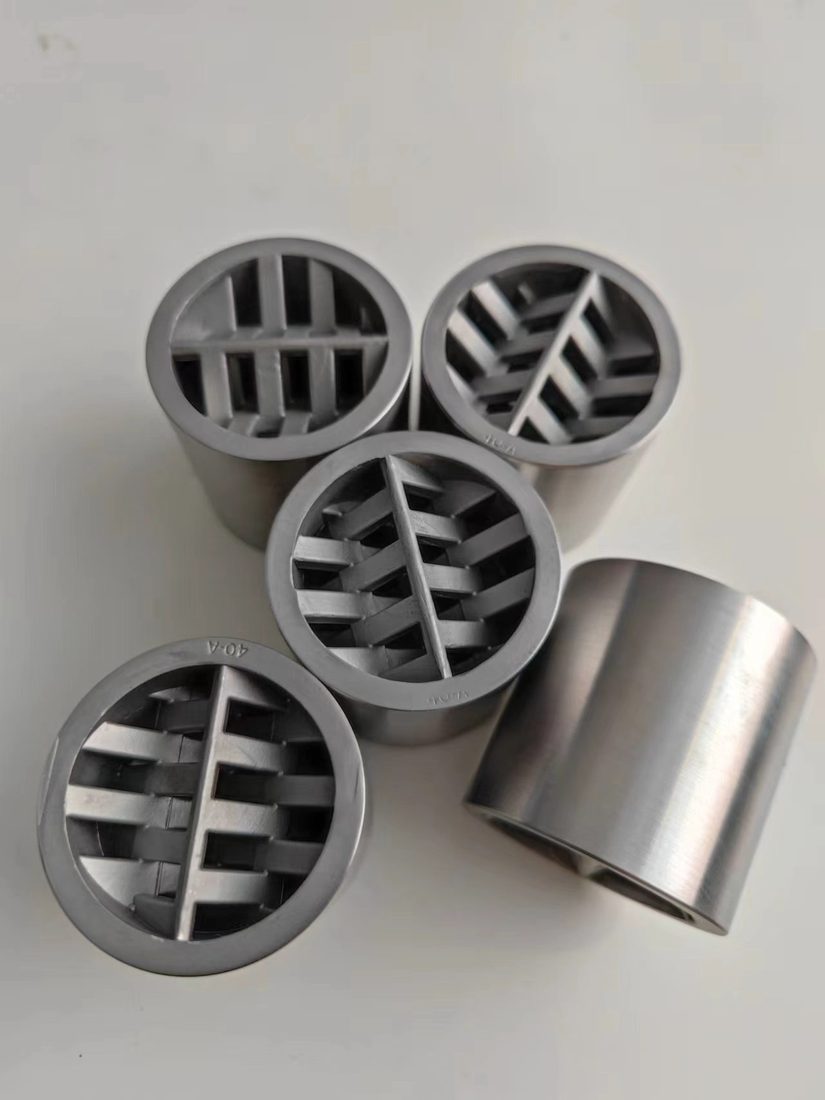
Where these formulas fit into a full selection, the sizing guide walks the complete procedure, and the pressure-drop calculation guide expands step 2 with optimization levers. Geometries referenced: SX cross-bar, SK helical, SV corrugated-plate.
FAQ
What formulas do I need to design a static mixer installation?
Six: area/velocity, Reynolds number, laminar and turbulent ΔP correlations, the Z-ratio, and mixing power P = γ·Q·h. Only K and C need the element supplier — everything else computes from your flow data.
How do I convert pressure drop into pumping power?
Head h = ΔP/γ, then P = γ·Q·h. That product is the mixer's entire energy cost — no motor, no seals, only headloss you pay for at the pump.
What is the Z-ratio for a static mixer?
Mixer ΔP divided by the empty-pipe ΔP over the same length and diameter. It compares element geometries at any scale — a Z of 20 costs 20 empty-pipe-equivalents of head regardless of diameter.
How many static mixer elements are typical?
Six to twenty-four, chosen from viscosity, target uniformity, and flow. Past the CoV target, each added element buys pressure drop, not mixing quality.
Sources: myengineeringtools static mixer pressure-drop reference (regime table, correlations, worked Kenics example ≈0.20 bar); mixing literature Z-ratio and Fanning-friction forms (peer-reviewed static mixer modeling studies); Lebaz et al., Chemical Engineering Journal 2019 (energy dissipation ε = ΔP·u_s/(ρLφ), SMX+ porosity 0.75, open archive hal-01966545); AJ Design mixing-power calculator P = γQh; ProMixUSA element-count guidance (6–24); Becht Engineering inline-mixing guide (Re ≥ 100,000 ≈ 100 diameters ≈ 95% mixed).