
Pressure drop per element is the quiet tiebreaker in every static mixer selection: two geometries that both hit your CoV target can differ by a factor of three in pumping cost. The comparison below uses the velocity-head ratings from our own specification pages, so the numbers match what a quotation will commit to.
The Ratings, Side by Side
| Parameter | SK helix | SX cross-bar | SV corrugated plate |
|---|---|---|---|
| Pressure drop rating | 1.5-3 velocity heads / element | 2-5 velocity heads / element | 0.1-0.5 bar across 8 elements at 2 m/s (water) |
| Viscosity ceiling | 1,000,000 cP | 10,000 cP | 100 cP |
| Dispersion precision | ≤ 10 μm | 2-5 μm | 1-2 μm |
| Elements to σX ≤ 5% | 5-8 (180° twist) | 4-6 | 4-8 (σX ≤ 1-5%) |
| Pipe range | DN15-DN500 | DN25-DN800 | DN15-DN1000 |
| Clogging tolerance | Lowest risk (open helix) | Moderate (~70% open area) | High risk (2-5 mm channels) |
Worked Example: DN50 Line at 1.5 m/s
One velocity head is ρv²/2. In water at 1.5 m/s that is about 1.1 kPa. Applying the ratings above to a six-element mixer:
| Geometry | Heads total (6 elements) | ΔP at design flow | ΔP at peak flow (×1.69) |
|---|---|---|---|
| SK | 9-18 heads | ≈ 0.10-0.20 bar | ≈ 0.17-0.34 bar |
| SX | 12-30 heads | ≈ 0.13-0.34 bar | ≈ 0.22-0.57 bar |
The 1.69 multiplier is not a safety guess: it is the square-law on a 30% velocity excursion (1.3² = 1.69), and our SX specification carries it explicitly. Budget the pump at peak flow, not average. The full derivation method — hydraulic-diameter approach, per-regime corrections — is in the pressure-drop calculation guide.
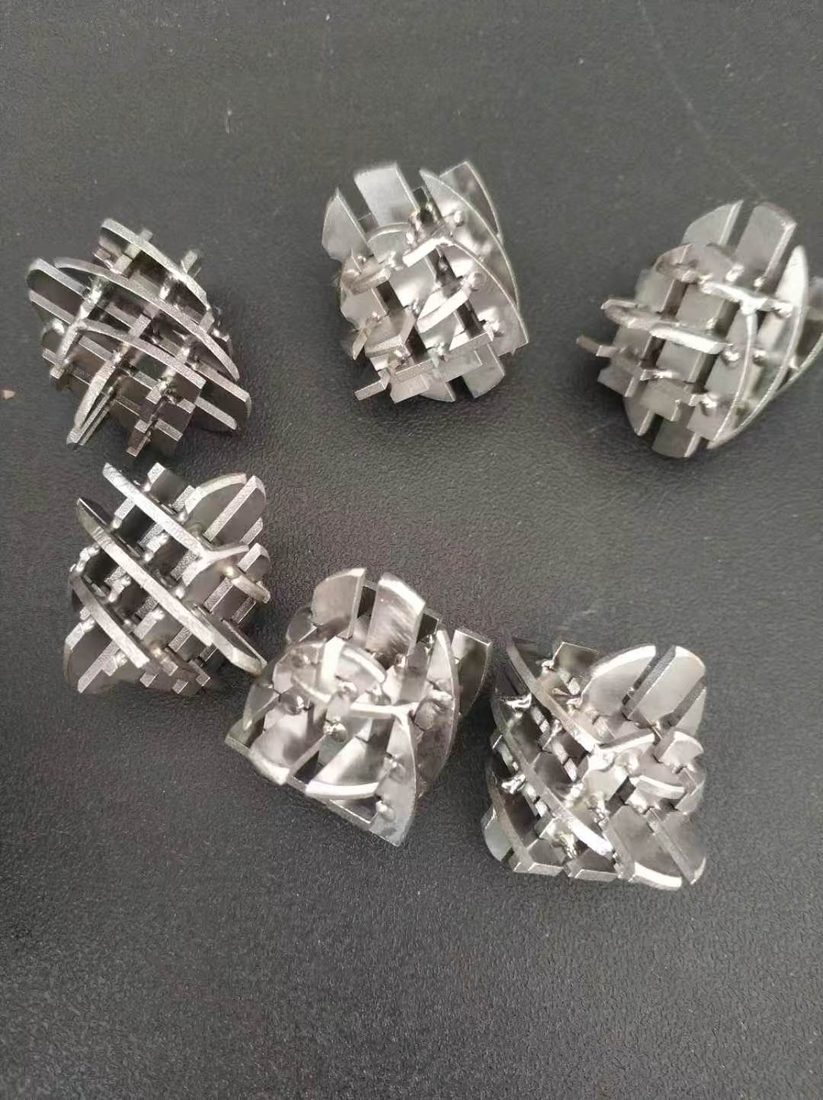
Why the Helix Is Cheap and the Cross-Bar Is Thorough
A 2025 peer-reviewed review of static mixers quantifies the trade: a helical element's friction factor is only about 5-6 times that of an empty pipe in laminar flow, while intensive cross-bar and grid geometries (the SMX class our SX belongs to) can run an order of magnitude higher — and need fewer elements, because each one cuts striations more aggressively (the review counts 10-15 helical elements to reach CoV < 0.05 in Newtonian laminar flow, versus about 5 for the most intensive geometries) (ACS Omega review, 2025). That is the whole deal in one sentence: the SK buys you the cheapest head per element and pays in element count; the SX pays more per element and finishes in fewer.
Pump-Head Decision Table
| If your duty is… | Pick | Because |
|---|---|---|
| Marginal pump head, viscous blending to 10⁶ cP | SK type | Lowest heads per element, open helix passes fibers |
| Mid-viscosity (to 10,000 cP) needing 2-5 μm | SX type | Fewer elements to target; fine dispersion without 2 mm channels |
| Clean, ≤ 100 cP, tightest CoV in compact length | SV type | Best mixing efficiency per unit length; spec-sheet ΔP committed per 8-element unit |
Between roughly 1,000 and 10,000 cP both SK and SX can run — see the sizing walkthrough for the element-count method before the pressure argument decides it.
FAQ
How do I convert velocity heads into bar?
ΔP = N × K × ρv²/2: element count × heads per element × one head. Water at 1.5 m/s makes one head ≈ 1.1 kPa, so 6 SX elements (2-5 heads each) land at 13-34 kPa ≈ 0.13-0.34 bar.
Which type has the lowest pressure drop per element?
The SK helix at 1.5-3 heads — consistent with published laminar data putting helical friction at only 5-6× an empty pipe versus an order of magnitude for intensive grid elements.
Does doubling the elements double the pressure drop?
In turbulent flow, yes — linear in element count. In deep laminar flow it grows faster than linear, so re-check the pump rather than extrapolating.
What does peak flow do to the budget?
ΔP scales with v²: a 30% velocity excursion costs 69% more pressure drop (the 1.69 factor our SX spec carries). Always verify at maximum flow.
Sources: ywmixing SV/SK/SX specification pages (velocity-head ratings, viscosity ceilings, dispersion figures, 1.69 peak-flow factor); "Static Mixers for High-Viscosity Systems: From Classical Helices to Machine-Learning-Optimized Geometries", ACS Omega (2025), DOI 10.1021/acsomega.5c08387 — helical friction factor ≈ 5-6× empty pipe, intensive geometries an order of magnitude higher, CoV < 0.05 at 10-15 helical elements. Head value ρv²/2 derived for water at 1.5 m/s.