
The first question most buyers ask about a static mixer is what it will cost, and the honest answer starts with construction class. A motionless mixer has no motor and no seals, so the price is essentially housing + elements + connections + paperwork. That structure produces surprisingly stable price bands across the market — stable enough to publish. The table below collects catalog price ranges from a US manufacturer that lists them openly, alongside the ex-works floor visible on China factory marketplaces.
Published Price Bands by Construction Class
| Construction class | Published band (USD) | What the band buys |
|---|---|---|
| PVC / CPVC | $191 – $1,281 | Low-pressure water and dosing duty; the budget entry point |
| PVDF (Kynar) | $469 – $1,406 | Halogen and acid service where plastics beat metals |
| PFA | $716 – $1,671 | Ultra-pure or aggressive service in small bore |
| Stainless 304/316 | $449 – $8,799 | The industrial workhorse band; top of range = large diameter |
| Sanitary hygienic (SS) | $1,346 – $9,340 | Electropolish, tri-clamp ends, CIP design, full documentation |
Bands: ProMixUSA published catalog ranges, accessed November 2026. China factory listings put the ex-works floor lower — SS316L DN50–DN200 SK-type units around $366, SS304 DN150 units with a dosing port at $350–360 — before freight and duties.
The Four Multipliers That Move the Number
1. Specification compliance — the biggest one. This is the round's research finding: an engineering-fabricator guide prices the same 16-inch static mixer at about US$12,000 without specifications and about US$50,000 with offshore oil-rig specifications — a 4× multiplier for paperwork, testing, and code welding alone (ZAIN Industrial, static mixing equipment guide). High-pressure units requiring ASME code welding and testing sit at the top of every vendor's range, and market research on the US inline-mixer market confirms engineered, custom units reaching $25,000–$150,000+ where sanitary-grade construction, precision tolerances, and automation integration stack up (IndexBox).
2. The sanitary premium. Sanitary inline mixers command a 40–80% premium over comparable industrial-grade units — the price of electropolished surfaces, sanitary fittings, clean-in-place capability, and the certificates validation teams read (IndexBox). The catalog bands above show the same effect: sanitary stainless starts where industrial stainless ends.
3. Raw materials. Nickel and molybdenum prices are volatile, and they pass directly into 316L and higher-alloy construction costs (IndexBox). This is why alloy quotes age fast and why plastic constructions sometimes win on economics alone in compatible duty — though stainless wins lifetime cost where corrosion, pressure, or temperature exclude plastics, as our materials comparison details.
4. Size. Large diameters are more expensive to fabricate in stainless steel — more weld passes, bigger element assemblies, heavier flanges. Element count rides on the same curve, which is why overspecifying elements "just to be safe" is money spent for pressure drop nobody asked for; the sizing procedure exists precisely to stop that.
The Landed-Cost Trap
Second finding, and the one procurement teams learn the hard way: on a live marketplace listing, a $59 stainless mixer carried $491 shipping for a single-set order — freight eight times the unit price. Cross-border purchases of small units are especially exposed, and tariff policy adds duties that vary by origin and product classification (IndexBox). Budget the landed cost, not the listing. The counterweight: a static mixer has no moving parts and near-zero maintenance, so the honest lifetime equation is landed price + installation + pumping energy for the pressure drop. That energy term is calculable before you buy — see the pressure-drop calculation guide and the per-element ratings in SK vs SX vs SV.
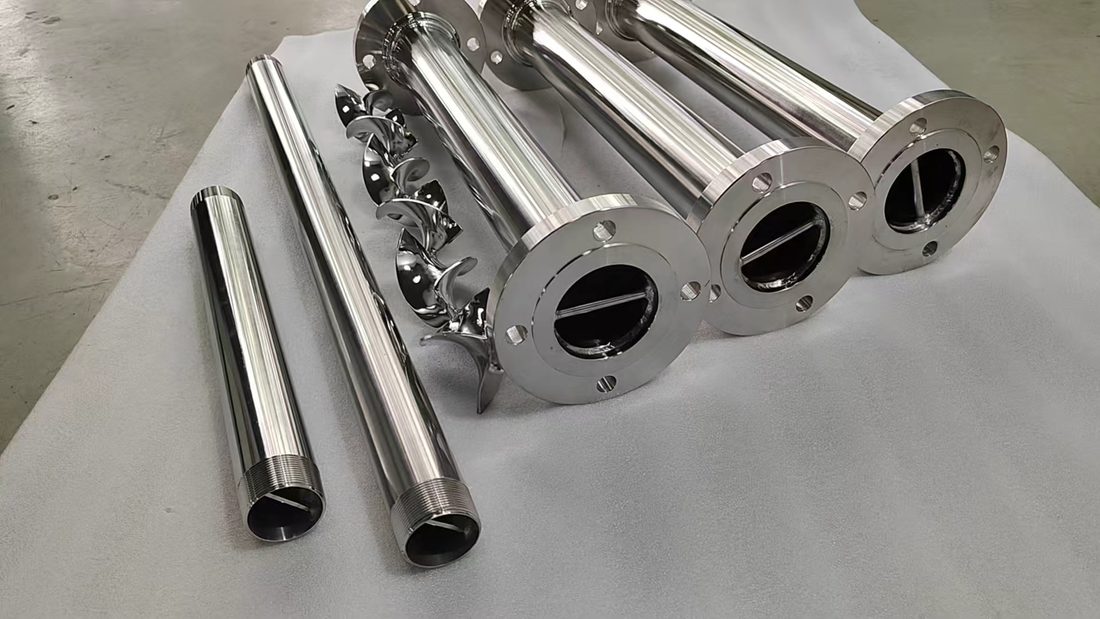
For a concrete number on your duty, skip the catalog guessing: send the line size, flow, fluid, and materials question to an engineer and get a sized quote — the SK-type and SX-type product pages list the construction options that drive each band.
FAQ
How much does a stainless steel static mixer cost?
Published US catalog bands run $449–$8,799 for industrial stainless depending on size and connections; China ex-works listings for SS316L DN50–DN200 units start around $366 before freight. Engineered builds scale from there — roughly $12k vs $50k for the same 16-inch unit without and with offshore specifications.
Why do sanitary static mixers cost 40–80% more than industrial ones?
Electropolished surfaces, sanitary fittings, CIP-capable design, and the documentation package — traceability, surface-finish reports, compliance statements. Catalog bands reflect it directly: industrial stainless $449–$8,799 versus sanitary $1,346–$9,340.
Does pipe diameter or material move the price more?
They move it differently: diameter drives fabrication labor (large stainless units are the most expensive to build), while material upgrades track volatile nickel and molybdenum prices. Plastics cut the material bill sharply in compatible duty — PVC/CPVC bands run $191–$1,281 against $716–$1,671 for PFA.
What hidden costs should I budget beyond the mixer price?
Freight (documented example: $491 shipping on a $59 unit), duties by origin and classification, installation, and lifetime pumping energy for the pressure drop. Maintenance is near zero — that is the static mixer's structural cost advantage.
Sources: ProMixUSA published catalog price ranges by construction class (accessed Nov 2026); IndexBox, "United States Inline Mixers Market" — commodity vs engineered price spans, 40–80% sanitary premium, nickel/molybdenum cost drivers, tariff exposure; ZAIN Industrial static mixing equipment guide — $12,000 vs $50,000 specification example for a 16-inch unit; Alibaba.com live supplier listings — China ex-works floor and shipping-to-unit ratio. All figures are published third-party data, not ywmixing quotes.