
CIP promises that cleaning fluid, run through the line at the right velocity and temperature, leaves every product-contact surface verified-clean — without opening anything. An inline static mixer is the one component that makes that promise hard: it packs a twisted helix or a stack of plates into the pipe, multiplying wetted area and hiding surfaces behind geometry the spray ball never sees directly. What CIP actually demands of a sanitary mixer is therefore not one thing but four: a cleanable internal geometry, honest velocity limits, drainability for SIP, and a paper trail validation can cite.
Why the Element Pack Stays Removable
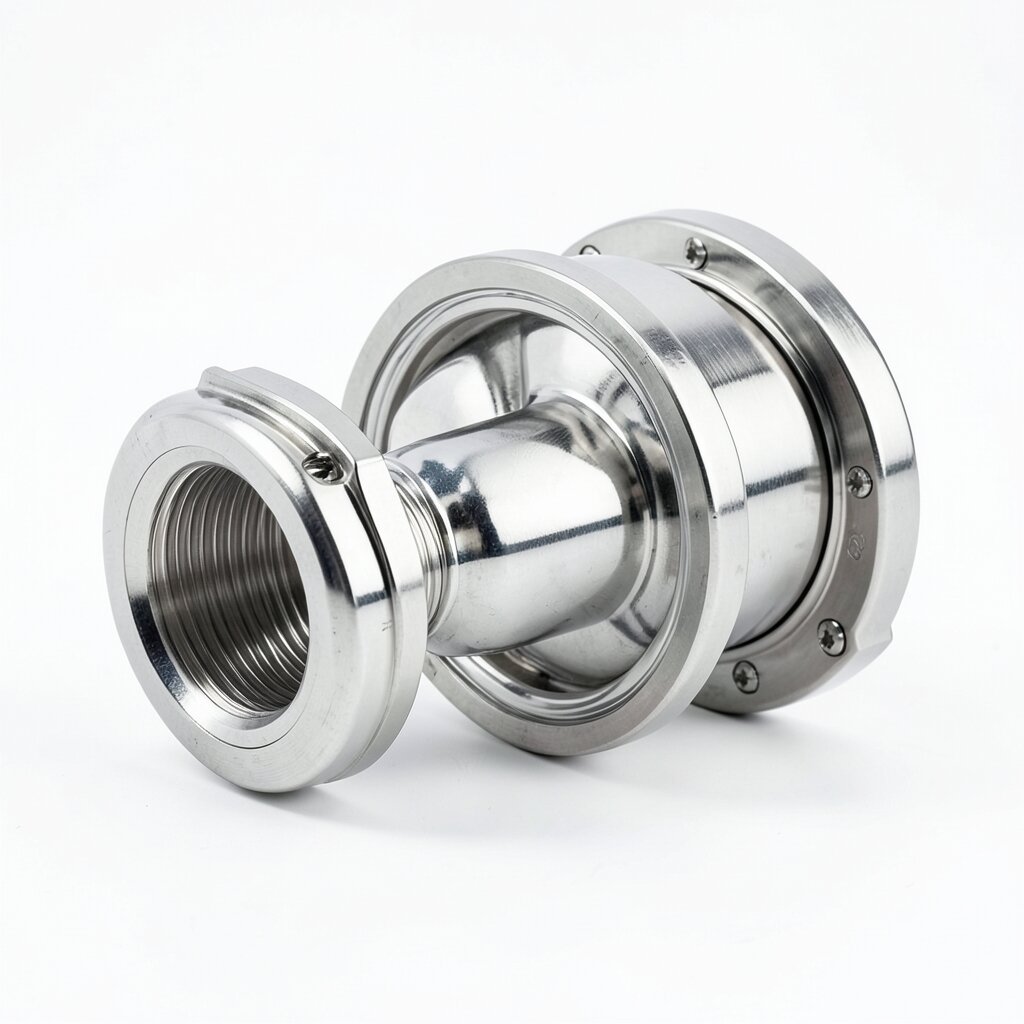
No CIP cycle can prove what it did inside a helix. Turbulence decays through the element channels, and the downstream inspector has no line of sight to the trailing edge of the third element. That is the engineering reason every serious sanitary static mixer — ours included — carries the elements as a removable pack: the element assembly slides into the housing on a precision spigot, and inspection means releasing two tri-clamps, sliding the housing out of the line, and lifting the pack out. On our standard sanitary mixer the swap takes under 10 minutes with no special tools, and the same hardware re-seats without breaking line alignment. Removability is not a service convenience; it is the only honest inspection method for the geometry, and it doubles as the fallback when a pack fouls badly enough that flow alone cannot recover it.
The 4 m/s Plateau: What CIP Flow Can and Cannot Clean
Our sanitary range specifies CIP at 1.5-2.5 m/s and customers often ask why the figure sounds low when the cleaning literature celebrates turbulence. The physics is worth stating plainly. EHEDG's guideline on CIP installations treats mean fluid velocity as the practical indicator of mechanical cleaning intensity, and the laminar sublayer at the wall — the film that actually shields soil from the bulk flow — converges to an asymptotic minimum somewhere above 4 m/s. Past that point, more velocity buys almost no extra cleaning; it buys pump energy, erosion risk at gaskets, and water bills. This is the round's research finding: there is a ceiling on what CIP velocity can do, and it sits near 4 m/s (EHEDG, "Hygienic Design Requirements for CIP Installations", Doc 50).
The practical consequence for a mixer: if product soil survives a validated cycle at 2-2.5 m/s, the answer is not to run the CIP skid faster — it is to open the tri-clamps and look at the pack. Between cycles, the geometry does the preventive work: polished channels with no crevices at the element-to-wall interface, Ra ≤ 0.8 μm product-contact finish, and full-penetration welds so there is no shadow line for soil to anchor in. For duties that never foul, a straight-through sanitary body reduces the wetted geometry further.
SIP: Steam Reaches the Pack Only If Condensate Leaves
Steam sterilization in place is specified on our sanitary mixers at 121-130°C, and the failure mode is never temperature — it is condensate. A pocket of water at the bottom of a housing sits near 100°C while the steam header reads 121°C, and the kill claim quietly invalidates. Hygienic piping guidance is explicit about this: product-contact runs must be self-draining, with a continuous slope (roughly 2° is the commonly cited minimum in ASME BPE/EHEDG-derived practice) and no dead legs beyond ~1.5 pipe diameters. An inline mixer respects those rules only if the installer does: mount it on the sloped run, keep the element tabs oriented downstream per the installation cheat sheet, and use gaskets rated for repeated steam cycles — ours are USP Class VI EPDM. Food-side requirements (FDA 21 CFR, EU 1935/2004) are covered in the dedicated food-grade design guide.
The Documents Validation Actually Reads
URS documents and IQ/OQ protocols are written against paper, not metal. A sanitary mixer earns its place in a validated line with the certificate package, and ours ships complete:
| CIP/SIP requirement | What the mixer supplies |
|---|---|
| Wetted material traceability | 3.1 MTR for the SS316L housing + ferrite content report |
| Cleanable surface | Surface-finish report (Ra ≤ 0.8 μm) + passivation certificate per ASTM A967 |
| Steam-cycle elastomers | USP Class VI certificate for EPDM gaskets |
| Hygienic design conformity | ASME BPE compliance statement; 3-A 18-03 / EHEDG Doc 8 on request |
| Food & dairy contact | FDA 21 CFR and EU 1935/2004 compliance statements |
| Validated CIP/SIP envelope | CIP 1.5-2.5 m/s; SIP 121-130°C; DN25-DN150; 3-8 elements; ΔP < 0.5 bar at max flow |
FAQ
Can CIP fluid actually clean inside a static mixer element?
Yes, within limits. CIP relies on flow-driven wall shear, and EHEDG guidance (Doc 50) puts the point of diminishing returns at roughly 4 m/s — beyond it, extra velocity barely thins the laminar sublayer that shields soil. Our mixers specify validated CIP at 1.5-2.5 m/s; a pack that still fails inspection comes out for manual cleaning, which is exactly why it is removable.
Why is the element pack removable if the line is validated?
Because no CIP cycle proves what it did inside a helix. Removability turns "trust the cycle" into "look at the surfaces": two tri-clamps, the pack slides out on its spigot, inspection done, re-seated without special tools in under 10 minutes.
How is SIP handled on a tri-clamp inline mixer?
At 121-130°C saturated steam, with the housing mounted on a self-draining sloped run so condensate cannot pool against the element pack. Gaskets are USP Class VI EPDM, rated for repeated steam cycles.
Which certificates support the validation package?
3.1 MTR and ferrite report for the housing, surface-finish report, ASTM A967 passivation certificate, USP Class VI EPDM certificate, and an ASME BPE compliance statement ship with every unit; 3-A 18-03 and EHEDG Doc 8 certificates are supplied on request, and FDA 21 CFR / EU 1935/2004 statements cover food and dairy service.
Sources: EHEDG, "Hygienic Design Requirements for CIP Installations" (Doc 50) — mean velocity as mechanical-cleaning indicator; cleaning benefit plateaus above ~4 m/s; self-draining slope and dead-leg limits per ASME BPE/EHEDG-derived hygienic piping practice. Product figures (CIP 1.5-2.5 m/s, SIP 121-130°C, Ra ≤ 0.8 μm, DN25-DN150, certificate list) from the ywmixing sanitary mixer specification page.