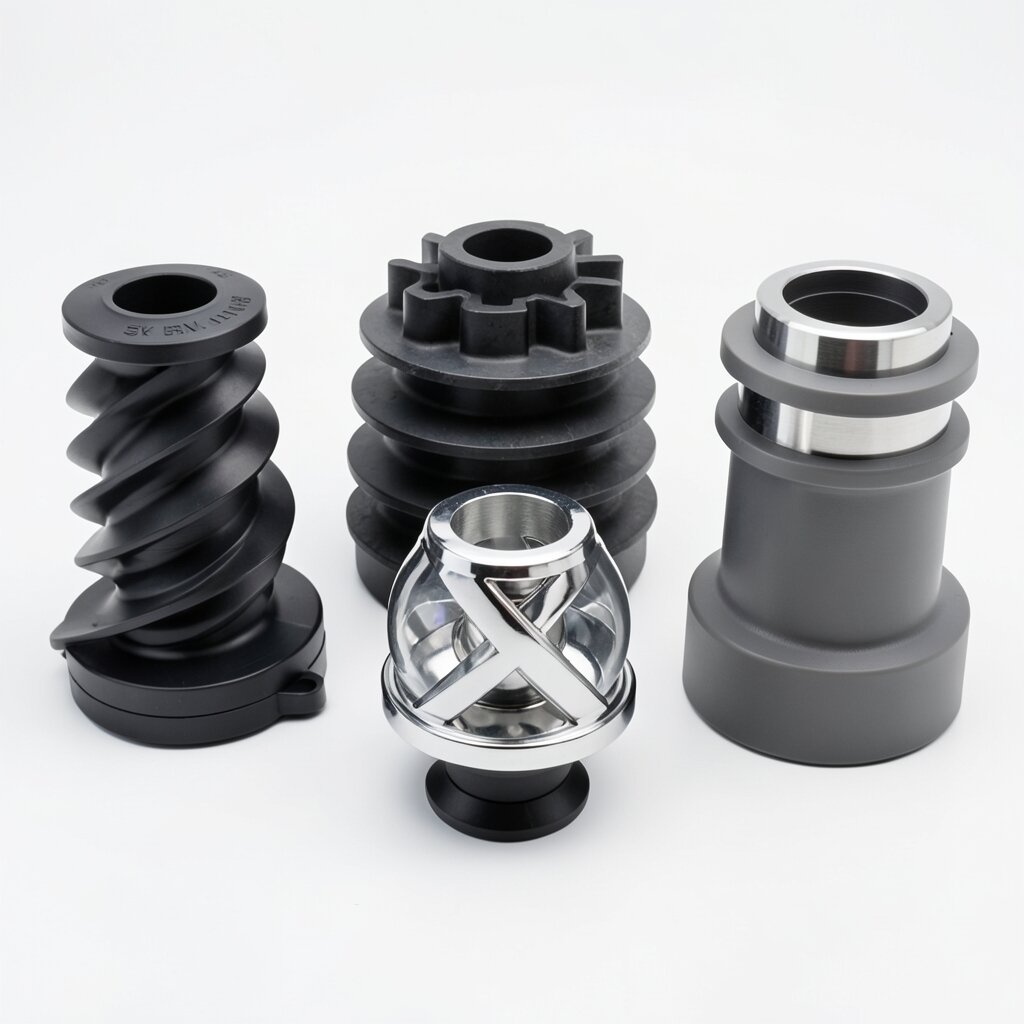
SL Type Single-X Static Mixer
Single-X Static Mixer
Heat-transfer-enhanced single-X element for low-viscosity service and viscous-product heating/cooling — combines blending with 3-5× wall-film heat-transfer improvement.
Product Overview
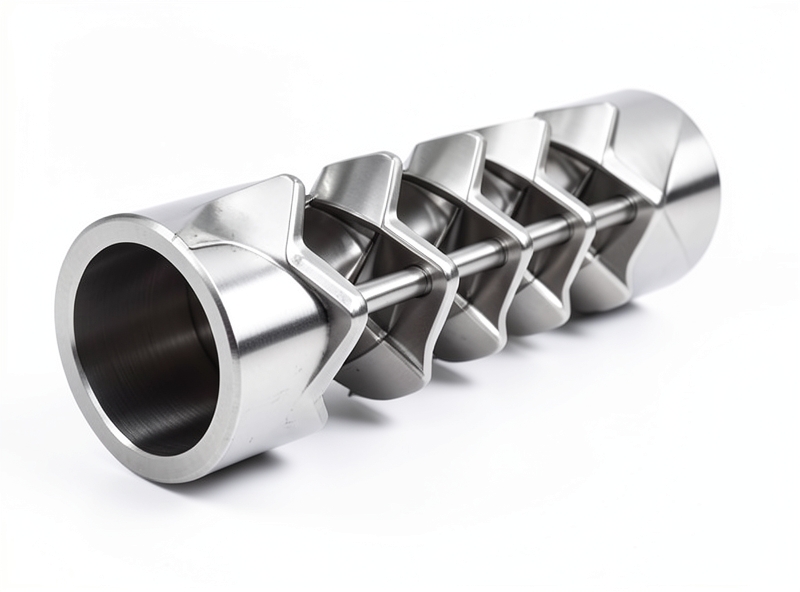
The SL type single-X static mixer is the model in the ywmixing range that we reach for when the process problem is fundamentally a heat-transfer problem with a mixing requirement attached, rather than the other way around. The element is a single set of crossed bars — an X-shape mounted in a short cylindrical housing, with a typical free cross-section of 75% of the pipe bore. The element's job is to interrupt the thermal boundary layer that forms at the inside wall of any pipe carrying a hot or cold fluid, and to push the bulk of the fluid into repeated contact with the wall. The result is a 3-5× increase in the inside-film heat-transfer coefficient compared to an empty pipe at the same flow rate.
The SL is also a competent mixer in its own right, but its dispersion precision is medium — coarser than the SV, SX, and SH. That is a deliberate trade-off. The X-bar geometry is a single interruption per element, not a multi-stage split-and-recombine geometry, so the SL achieves only modest reduction of concentration non-uniformity. Where the SL excels is in duties that combine blending with thermal management: a heated reactor feed where the reagents must reach the reaction temperature at the same time they reach the reactor, a viscous product that must be cooled from 150°C to 40°C before it can be packaged, or a process stream that must be conditioned to within ±1°C of a setpoint.
The viscosity envelope is the SL's most distinctive feature. It is rated for fluids up to 10 cP (water-like) or for polymer solutions at any viscosity — the "polymer media" exception in our specification reflects the fact that high-molecular-weight polymer solutions are shear-thinning and behave like low-viscosity fluids once they are moving. This dual envelope means the SL can be specified for both the heating side (low-viscosity heat-transfer fluid in the jacket) and the process side (viscous polymer in the pipe) of a single process.
Working Principle
The SL element consists of two rectangular bars welded or mechanically fastened at the pipe centerline to form an X. The bar width is typically 0.10-0.15 times the pipe diameter, and the bar thickness is 3-5 mm for SS316L or 5-8 mm for carbon steel. The element length is 1.0-1.5D. In a typical installation, two or three elements are stacked inside a housing of overall length 4-6D, with no rotation between elements (the X orientation is the same for every element, so the flow sees the same X-pattern repeatedly).
From a heat-transfer perspective, the X-bars work by two mechanisms. First, the bars physically obstruct the flow near the wall, forcing fluid from the cooler (or warmer) wall region into the bulk. This disrupts the thermal boundary layer and replaces it with a thinner one each time the fluid passes an element. Second, the bars shed vortices into the downstream flow, which mix the wall-adjacent fluid with the core fluid through turbulent (or pseudo-turbulent in laminar flow) eddy transport. The net effect is that the temperature profile across the pipe becomes much flatter than in an empty pipe, where the wall-adjacent layer can be 5-10°C different from the core even in fully developed flow.
From a mixing perspective, the X-bars split the flow into four quadrants, similar to the SX but without the rotation between elements. Each quadrant is forced to merge with its neighbor at the trailing edge of the X, producing a 4-to-1 stream reduction at each element. Over 3 elements, the fluid has been split 64 times — which is enough to bring σX down to about 5%, but not enough to reach the 1-5% band that the SV, SK, SX, and SH can deliver. For most heat-transfer-dominated processes, 5% is more than sufficient, because the downstream thermal relaxation takes care of the remaining non-uniformity.
The SL is one of the few static mixers in the industry that is explicitly designed to operate in the laminar regime. In laminar flow (Re < 2,300), an empty pipe is a poor mixer because the parabolic velocity profile means fluid in the center moves much faster than fluid at the wall. The X-bars force the slow wall fluid to re-merge with the fast core fluid, eliminating the parabolic profile over a length of about 3-5 elements.
Technical Specifications
| Parameter | Value |
|---|---|
| Internal Structure | Crossed bars forming single X-shaped units; 2-3 elements per housing (no inter-element rotation) |
| Dispersion Precision | Medium — σX ≤ 5% with 3 elements (not the precision leader) |
| Viscosity Range | ≤ 10 cP for Newtonian fluids; or any viscosity for shear-thinning polymer media |
| Pressure Drop | Moderate; 1-2 velocity heads per element (lowest of the five models) |
| Non-Uniformity Coefficient | σX ≤ 5% with 2-3 elements (in turbulent service); σX ≤ 3% with 3 elements (in laminar service with thermal relaxation) |
| Material Options | SS304, SS316L, Carbon Steel, PVC, PP, Hastelloy C-276 |
| Connection Types | Flange (ANSI / DIN / JIS), Threaded (NPT / BSP), Welded, Tri-Clamp |
| Temperature Range | -50°C to +300°C (metallic) / -10°C to +80°C (PVC/PP) |
| Pipe Diameter Range | DN15 to DN600 |
| Flow Rate Range | 0.05 to 1,200 m³/h (model and pipe-size dependent) |
| Heat-Transfer Enhancement | 3-5× inside-film coefficient vs empty pipe at the same flow rate |
| Internal Structure | Single-X bars Corrugated plates Helical twist Crossed bars Dual-channel helical |
| Dispersion Precision | Medium 1-2 μm ≤ 10 μm 2-5 μm 1-2 mm |
| Max Viscosity (cP) | 10 (or polymer) 100 1,000,000 10,000 1,000,000 |
| Pipe Diameter | DN15-DN600 DN15-DN1000 DN15-DN500 DN25-DN800 DN15-DN200 |
| Clogging Risk | Low High Lowest Moderate Moderate |
| Best For | Heat transfer Fine dispersion High-viscosity Mid-range High-viscosity clean |
Frequently Asked Questions
The SL element's X-bar geometry interrupts the thermal boundary layer at the pipe wall and creates radial mixing. For heat-transfer service, this typically increases the inside-film heat-transfer coefficient by a factor of 3-5 compared to an empty pipe at the same flow rate.
Yes. The SL's heat-transfer enhancement is symmetric — it works equally well for cooling (process fluid hotter than the wall) and heating (process fluid colder than the wall). Typical installations include viscous product cooling from 150°C to 40°C and chilled-water heating of process streams from 5°C to 25°C.
The metallic SL is rated for -50°C to +300°C; PVC/PP versions are limited to -10°C to +80°C. For service above 300°C, special high-temperature alloys (Inconel 625, Hastelloy X) are available on request.
Yes — in fact, the SL is one of the few static mixers that is explicitly designed to operate in the laminar regime. The X-bar element provides a fixed geometry that disrupts the parabolic velocity profile and forces radial mixing, which plain pipe cannot achieve at Re < 2,300.
Both use crossed bars, but the SL uses single X-units (one X per element) while the SX uses a more complex X-on-X or X-on-plus arrangement. The SL produces medium dispersion and emphasizes heat transfer, while the SX produces finer dispersion (2-5 μm) and emphasizes blending.
Related Products