
Scaling static mixers from a DN15 bench rig to DN500 production is the rare scale-up that gets easier as it grows. The element count that met your CoV target in the lab is near scale-invariant; what changes underneath is the Reynolds number, element construction, and velocity economics.
What Transfers Unchanged
Element count. Every element doubles the striation layers (n elements → 2n layers) regardless of diameter, so the CoV target maps to the same count at DN15 and DN500. In turbulent flow, published guidance puts complete mixing at just 4-6 elements (KLM Tech Group static mixer design guideline, Rev 2.1).
Velocity and its pressure-drop price. Velocity-head ratings are diameter-independent: our SX cross-bar runs 2-5 heads per element, the SK helix 1.5-3, at any DN. Hold velocity in the 1-2 m/s window and the millibar budget travels with you — see the sizing walkthrough.
The Reynolds Effect: Big Pipes Mix Easier
Reynolds number carries diameter in its numerator: Re = ρvD/μ. At the same 1.5 m/s water velocity, DN15 operates at Re ≈ 22,500; DN500 reaches ≈ 750,000 — 33× deeper into turbulence. Stirred-tank scale-up authorities state the same effect: size enters Re as a squared factor, so viscosity matters less as scale goes up, and mixing may actually get easier (Chemical Processing). A lab unit near the turbulent transition is thus a conservative worst case for the production mixer behind it.
| Line size | Flow at 1.5 m/s (water) | Reynolds number | Regime note |
|---|---|---|---|
| DN15 (lab) | 1.0 m³/h | ≈ 22,500 | Edge of turbulent |
| DN50 (pilot) | 10.6 m³/h | ≈ 75,000 | Deep turbulent |
| DN150 | 95.4 m³/h | ≈ 225,000 | Deep turbulent |
| DN500 (production) | 1,060 m³/h | ≈ 750,000 | Rough-turbulent |
What Does Not Transfer
Regime assumptions. The same KLM guideline is explicit: for low-flow or high-viscosity service the element count for a homogeneous blend "increases significantly." If the lab loop ran turbulent but the plant line turns transitional at turndown, re-specify the count — do not scale it.
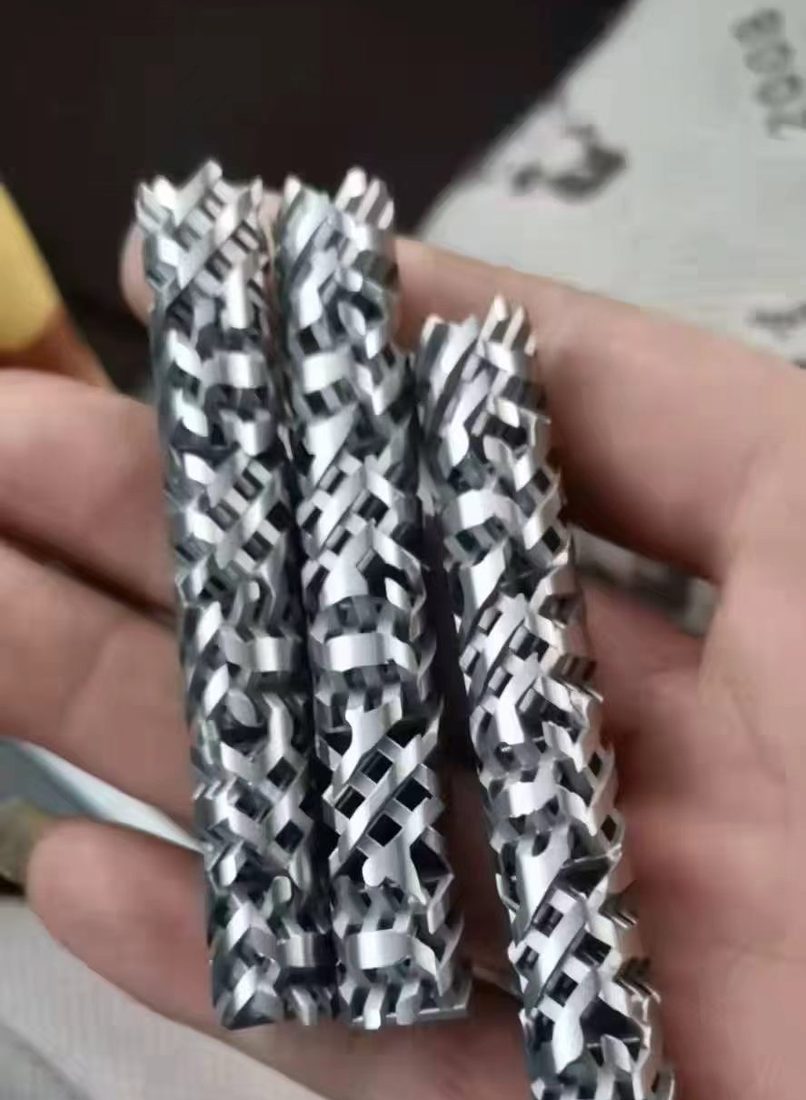
Mechanical construction. A DN15 element is a welded ribbon; above DN600 our SX cross-bars ship as bolted segments that pass through standard flanges. Solids tolerance narrows too — fibers can blind a large element. Replacement mixing elements for both scales are stocked.
A Five-Step Scaling Protocol
| Step | Check | Pass criterion |
|---|---|---|
| 1. Fix velocity | Velocity at design flow | 1-2 m/s for water-like service |
| 2. Compare regimes | Re at lab DN and production DN | Both turbulent; if lab borderline, add one element |
| 3. Carry element count | Count that met lab CoV | Raise only for viscous duty |
| 4. Re-budget ΔP at peak flow | Total dP at maximum velocity | v²-scaled dP stays inside pump margin |
| 5. Verify mechanics | Flange access, solids | Elements pass flanges; open area passes solids |
FAQ
Do production-size static mixers need more elements than lab units?
Usually no. Element count is set by the CoV target and the flow regime, not the diameter — each element doubles the striation layers regardless of size. In the turbulent regime 4-6 elements complete the mixing regardless of DN; only low-flow or high-viscosity duties need the element count raised significantly (KLM static mixer design guideline).
Does pressure drop per element change with pipe diameter?
Not in velocity-head terms. Ratings such as 1.5-3 heads per SK element or 2-5 per SX element apply across sizes — one velocity head is ρv²/2, so the same superficial velocity keeps roughly the same millibar budget per element. Pumping cost still scales with total flow.
Can I validate on DN15 and order DN300?
For turbulent, water-like duties at matched velocity — yes, and it is standard practice. Compute Reynolds number at both scales first: at the same 1.5 m/s in water, DN15 runs Re ≈ 22,500 while DN300 runs Re ≈ 450,000, so the production unit sits deeper in the regime where lab results transfer conservatively.
When does lab-to-plant scaling fail?
When the regime shifts: a lab loop in clean turbulent flow cannot predict a production line that turns transitional or laminar at turndown; when the fluid is non-Newtonian or shear-sensitive; when fibers or solids load the stream; or when a fast competitive reaction needs residence-time control the larger housing changes.
Sources: KLM Tech Group, "Engineering Design Guidelines: Static Mixer" Rev 2.1 (element counts in turbulent vs viscous service; scale-up criteria established for turbulent multiphase flows); Chemical Processing, "Succeed At Mixing Scale-up" (Re rising with size — viscosity impact falls at scale); ywmixing SX/SK specification pages (velocity-head ratings, DN600+ segmented construction). Reynolds numbers derived from Re = ρvD/μ at 1.5 m/s, water at 20 °C.