Every plant that blends, doses, or reacts fluids owns both technologies: the agitated tank and the inline static mixer. The wrong allocation is expensive in both directions — a static mixer asked to dissolve powder or suspend solids will blind and block, while an agitated tank doing a job a pipe section could do burns motor power and floor space for no benefit. The cleanest decision variable is not viscosity, budget, or vendor preference. It is residence time: how long the process material must stay in contact, and who controls that duration.
The Two Devices Answer Two Different Questions
An agitator mixes a fixed volume repeatedly. The impeller circulates the tank contents through a shear zone over and over, and the batch approaches uniformity after many turnovers. The operator decides how long to mix — one minute or one hour — which is exactly what dissolution, crystallization, and batch reactions require. A static mixer does the opposite: it mixes a flowing stream exactly once, using fixed elements that split, rotate, and recombine the fluid in a single pass through the pipe.
The residence-time consequence is dramatic, and it is quantified in a Kenics technical paper on process intensification (published by Brown & Morrison): stirred tanks typically provide residence times on the order of hours, days, or even weeks, while inline static mixers work in seconds to minutes. That single order-of-magnitude gap drives most of the selection logic below.
When the Agitator Tank Wins
The tank is the right answer whenever the process is governed by time rather than by a single pass:
- Batch operation. If the product is made batch by batch, there is no continuous stream to mix inline — the vessel is the process.
- Dissolution and Powder Incorporation. Dissolving a solid requires contact time; a static mixer cannot supply it, and undissolved particles pack into the element channels.
- Solids suspension. A slurry left unagitated settles and stratifies, tank or no tank in the line. Only an impeller can hold solids in suspension indefinitely — a static mixer cannot act on a stationary volume at all.
- Slow reactions and heat transfer. Any reaction with a measurable rate, crystallization, fermentation, or duty that needs jacket heating or cooling surface belongs in a vessel.
- High viscosity. Static mixers handle laminar viscous blending well, but the pressure drop — and therefore the pumping cost — rises steeply with viscosity. Beyond a certain viscosity the tank agitator is simply the more economical energy source.
When the Inline Static Mixer Wins
The static mixer wins wherever two streams are already flowing and only need to become one:
- Continuous blending of similar-viscosity liquids in a production line — dilution, component blending, solvent switching.
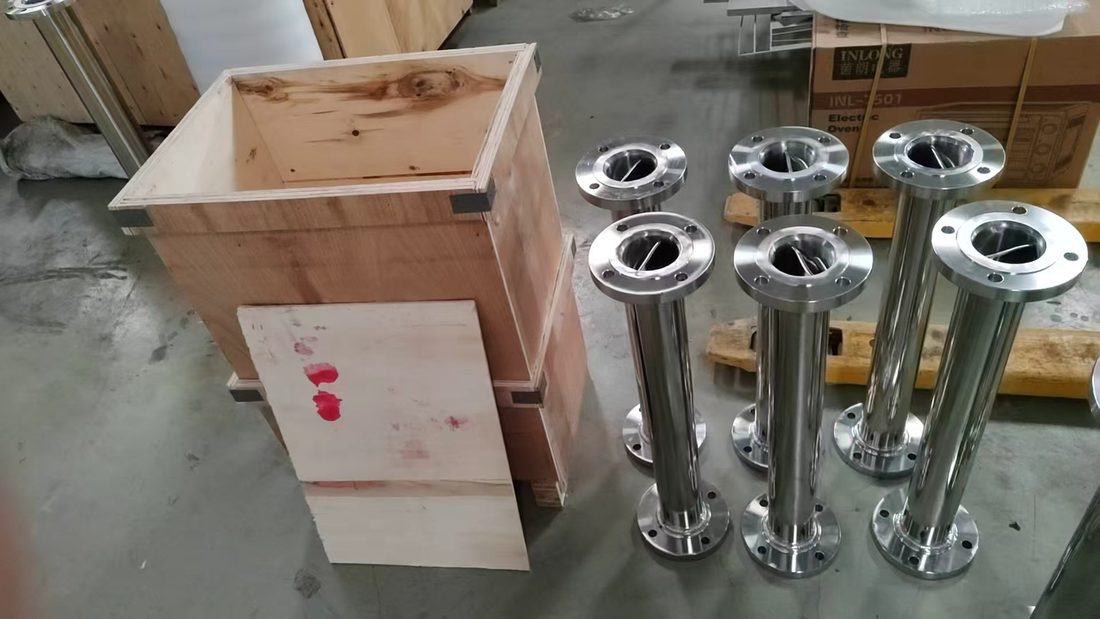
- Chemical dosing and injection. Dispersing a dosed additive into a pipeline right after the injection quill, before it can ride along the pipe wall unmixed. Our SV-type mixer is built for exactly this low-viscosity duty.
- pH correction where acid or caustic must be fully dispersed before an inline analyzer or a discharge point.
- Fast competitive reactions. The same Kenics paper makes the sharpest practical point in this comparison: in fast reactions, a stirred tank needs minutes of circulation just to reach uniformity, while a static mixer achieves blending within seconds — and when competing reactions race for the same reagent, the mixing time is part of the chemistry. Selectivity can depend on the mixer.
- Degradation-sensitive products. Products that degrade with time should not sit in a large vessel; the short, fixed residence time of an inline mixer is a process advantage, not a limitation.
- Hazardous or explosive areas. No motor, no shaft seal, no rotating equipment — the mixer contributes no ignition source, and there is no seal to maintain.
The Decision Table
| Duty | Winner | Why |
|---|---|---|
| Continuous blend, low viscosity | Static mixer | Single pass, no motor, near-zero maintenance |
| Additive dosing into a pipeline | Static mixer | Disperses at the injection point in seconds |
| Fast competitive reaction | Static mixer | Seconds-scale mixing protects selectivity (Kenics) |
| Time-degrading product | Static mixer | Fixed short residence time, no hold-up volume |
| Batch process | Agitator tank | No continuous stream exists to mix inline |
| Dissolving powder / polymer makedown | Agitator tank | Needs contact time; solids would blind elements |
| Solids suspension in storage | Agitator tank | Mixer cannot act on a stationary volume |
| Slow reaction, crystallization, jacket cooling | Agitator tank | Residence time and heat-transfer surface |
The Energy Question, Answered Structurally
Vendor literature often compares kW figures, but the structural difference matters more than any single number. An agitated tank spends energy recirculating its entire volume — every litre must pass the impeller several times before the batch is uniform, and the agitator keeps running whether or not product is flowing. An inline static mixer spends energy only on the stream that actually flows, and only as pressure drop across a meter of elements, absorbed by a pump that usually has margin to spare. For a continuous blending duty, the mixer's total energy per tonne of product is almost always lower; for a batch duty there is no contest to judge, because the mixer cannot do the job at all.
The pressure-drop penalty is real but bounded: our pressure-drop calculation guide shows worked examples in which a full-size mixer in water duty costs a few hundredths of a bar, and a viscous polymer duty about 0.1 bar — both within the margin of a normally specified pump.
Most Plants Use Both — In Sequence
The comparison is often framed as either/or, but the mature answer in dosing service is both, each doing what it does best. A typical chemical dosing skid runs: an agitated make-down tank (dissolve and hold the chemical homogeneous) → a metering pump (accurate flow) → an injection quill → a SK-type static mixer for high-viscosity concentrates or an SV for thin ones (positive dispersion into the main stream) → an analyzer or the process. Selection engineering practice, as summarized in comparisons by mixing-equipment engineers such as Verito Engineering, converges on the same rule: residence time separates the two devices, and most plants deploy them in series.
Summary
Choose by residence time first: if the process is complete in one pass through a pipe, the inline static mixer is smaller, cheaper to run, and maintenance-free; if the process needs time, volume, or heat-transfer surface, the agitated tank is not optional. Then check the exclusions — solids that settle, powders to dissolve, viscosities that blow the pressure budget — and the answer is usually unambiguous. If you are unsure which side of the line your duty falls on, send us the flow rate, viscosity, and process goal, and we will tell you honestly — including when our mixer is the wrong tool.
Frequently Asked Questions
Only when the duty is a single-pass blend of flowing streams and the process needs seconds — not minutes — of contact. Anything that needs controlled residence time, solids suspension, dissolution, or heat-transfer surface still requires a vessel. Most plants end up using both in sequence rather than replacing one with the other.
An agitator holds the batch for as long as the operator wants — minutes, hours, or days — while a static mixer offers only the few seconds the fluid takes to traverse a few pipe diameters. If the process goal is achieved in one pass, the mixer is cheaper and simpler; if the process needs time (dissolution, reaction, crystal growth), only a tank can provide it.
For continuous blending of low- to medium-viscosity fluids, yes: the only energy cost is the pressure drop across the elements, paid by the existing pump. An agitated tank continuously recirculates its entire volume to achieve what a short pipe section achieves in a single pass. But the mixer pays a pressure-drop penalty at high viscosity, and a slurry can blind the elements — duties where the tank remains the right answer.
The common arrangement in chemical dosing: a small agitated tank prepares and holds the chemical (dissolving powder, keeping it homogeneous), a metering pump feeds it into the process line, and a static mixer immediately downstream of the injection point disperses the concentrate into the main flow. Each device does the job it is best at.
Related reading: Static Mixer vs Dynamic Mixer covers the inline-vs-rotating equipment comparison, and the static mixer sizing guide takes you from process data to element count once the inline route is confirmed.