
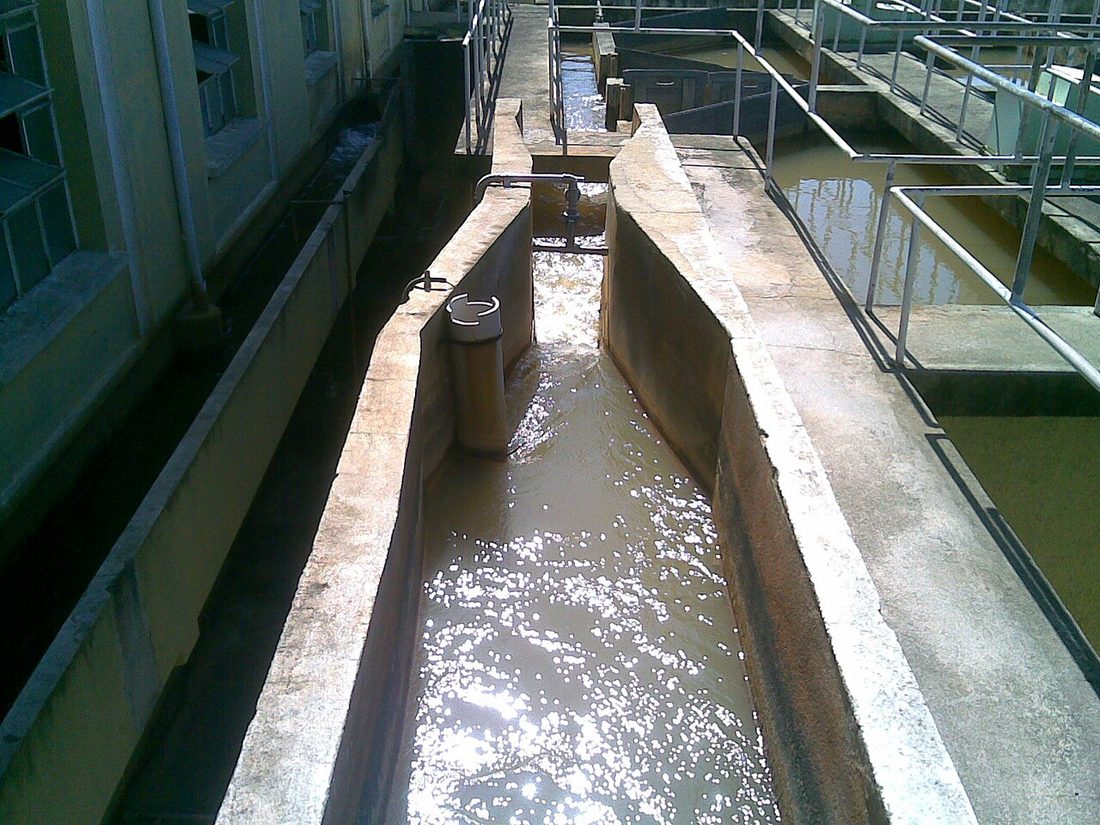
Most of the mixing hardware discussed on this site lives inside a pressurized pipe. But a large share of municipal water and wastewater treatment happens in open channels — rectangular concrete conduits flowing part-full with a free water surface — where chemicals must be dosed and dispersed without the benefit of pump pressure. An open channel static mixer solves this with fixed elements that span the channel cross-section, and the engineering realities that govern it are quite different from pipe mixing.
Reality 1: The Headloss Budget Is Millimetres, Not Bar
A pipe static mixer typically costs 0.1–1 bar of pressure drop, paid for by the pump. In an open channel there is no pump to pay it — the only driving force is the water surface slope itself. Channel mixer designs therefore target headloss of just a few millimetres of water column; mixer manufacturer Statiflo notes that with headlosses this low, gravity flow through the mixer is a practical option, eliminating pumping capital, maintenance and energy entirely. This is why channel mixing is attractive at treatment works: the mixer is inserted into flow that is already moving downhill, and the plant's existing hydraulic gradient absorbs the loss. The design check that matters is freeboard — the mixer's backing-up effect must not push the upstream water level over the channel wall at peak flow.
Reality 2: Velocity Profiles Are Ugly, So Injection Must Follow Them
Inside a full pipe, the velocity profile is predictable. Open channels — especially wide, shallow ones — develop unusual velocity profiles that do not exist in piping: dead zones near the walls, surface currents faster than the bed, and lateral skew after bends. Mixing elements can homogenize the cross-section, but only if the chemical is introduced in proportion to the local flow at each injection point. Statiflo has invested specifically in procedures that proportion additive injection to the local mainstream flowrate across the channel. The practical takeaway for a plant designer: in a channel, the injection sparger layout is not an accessory to the mixer — it is half of the mixing problem. (The same dosing-loop logic in pressurized lines is covered in our water treatment static mixer guide.)
Reality 3: Ragging Is the First Failure Mode
Municipal wastewater carries rags, wipes and stringy fibrous material, and any vane or element edge in the flow collects them. In raw-sewage channels, ragging — fibres wrapping around the mixer — is the first thing that fails, not the mixing performance. Dedicated channel mixers for sewage service are engineered explicitly against it: Statiflo's non-ragging channel mixer (NRC), designed for phosphorus-removal dosing in raw sewage, uses variable-angle control vanes, an integral accessible sparger, and subsurface fixed vanes, with an open geometry that lets debris pass. Komax specifies the same philosophy for its channel mixers: an open design that passes debris without clogging, built from alternating right- and left-rotation elements set 90° apart. For any raw-sewage duty, ask the vendor specifically how the geometry handles rags — a scaled-down pipe mixer bolted into a channel will blind over.
Reality 4: The Channels Are Big
Channel mixers are not lab hardware. Westfall's open-channel Model 4000, for example, mounts on a bulkhead or stands mid-channel and serves flows in channels up to roughly 20 ft (6 m) wide and 20 ft deep — irrigation ditches and plant channels alike, using one to three stages of symmetrically placed vanes. Elements are modular so the aspect ratio can be adapted: square sections, narrow-deep channels, and wide-shallow channels each need a different vane arrangement. Retrofit into existing, even flooded and live channels is a standard requirement — plants cannot afford to take their only treatment train offline for a mixer installation.
Where Channel Mixers Sit in a Treatment Plant
Komax's application notes describe the two classic duty points. At the plant influent, channel mixers disperse coagulants and flocculants into raw (influent) water ahead of the clarifier. At the effluent, they mix chlorine for disinfection — and sodium bisulphite for dechlorination — ahead of discharge to the receiving river or lake. Both are gravity, low-headloss, high-flow duties. The selection table below summarizes how duty maps to configuration:
| Channel duty | Mixing task | Configuration that fits |
|---|---|---|
| Influent coagulation / flocculation | Radial dispersion of dose across full cross-section | Full-span element bank + proportioning sparger |
| Raw sewage chemical dosing (e.g. P-removal) | Dosing without rag build-up | Non-ragging open geometry, control vanes, accessible sparger |
| Effluent chlorination / dechlorination | Fast, uniform kill-dose dispersion before outfall | Short element bank near injection point; millimetre headloss |
| Narrow channel / small works | Standard mixing duty | Closed-duct section + standard pipe static mixer (see below) |
The Retrofit Path: Turn the Channel Into a Pipe
There is a cheaper option that plants with modest channel sizes should evaluate first: install a short closed duct section in the channel — an enclosed rectangular or circular conduit that runs just full — and put a standard pipe static mixer inside it. This converts the local hydraulics from free-surface to full-pipe flow, which is exactly the regime our SV corrugated-plate and SK helical mixers are built for; both are available in corrosion-resistant materials suited to chlorine dosing service. The duct adds some headloss relative to an open element bank, but the mixer becomes a catalogue item with known CoV performance instead of a custom channel fabrication, and chemical injection can use standard multi-inlet or quill arrangements. Channel-dedicated hardware earns its cost where the channel is wide, the flow cannot be interrupted, or ragging demands special geometry.
Summary
Open channel static mixing is governed by four realities: a headloss budget measured in millimetres that enables gravity operation, irregular velocity profiles that force flow-proportioned injection, ragging as the dominant failure mode in raw sewage, and channel dimensions far beyond pipe sizes. Where the channel is small enough, converting a section to closed duct and fitting a standard inline mixer is the lowest-cost route; where it is not, purpose-built non-ragging channel geometry with a proportioning sparger is the correct answer. Send us your channel dimensions and chemical dosing duty and we will tell you honestly which of the two routes fits.
Frequently Asked Questions
Can a standard pipe static mixer be used in an open channel?
Not directly — a pipe mixer is a full-pipe, pressurized device. Either keep the free surface and use a dedicated channel-mixer geometry, or convert a short channel section into a closed duct and install a standard inline mixer there. The closed-duct conversion is usually cheaper because the mixer becomes a catalogue item.
How much headloss does an open channel static mixer add?
Well-designed channel mixers add only a few millimetres of water column, which is what makes gravity flow through the mixer possible — no pumping, no power. The check that remains is that the backing-up effect does not exceed the channel's freeboard at peak flow.
What fails first in wastewater channel mixers?
Ragging — rags, wipes and fibrous strings wrapping around the vanes. Non-ragging designs counter it with open frameworks, sloped leading edges and variable-angle control vanes so debris passes through instead of accumulating.
Where in a wastewater plant are channel mixers installed?
Typically at two points: the influent, dispersing coagulants and flocculants ahead of the clarifier, and the effluent, mixing chlorine for disinfection or sodium bisulphite for dechlorination ahead of the outfall.
Sources: Statiflo Channel & Duct Static Mixers and Non-Ragging Channel Mixer technical pages (headloss/gravity flow, velocity-profile proportioning, NRC geometry); Komax Channel Static Mixer application notes (influent/effluent duties, element rotation scheme); Westfall Model 4000 open-channel mixer specifications (channel size envelope).